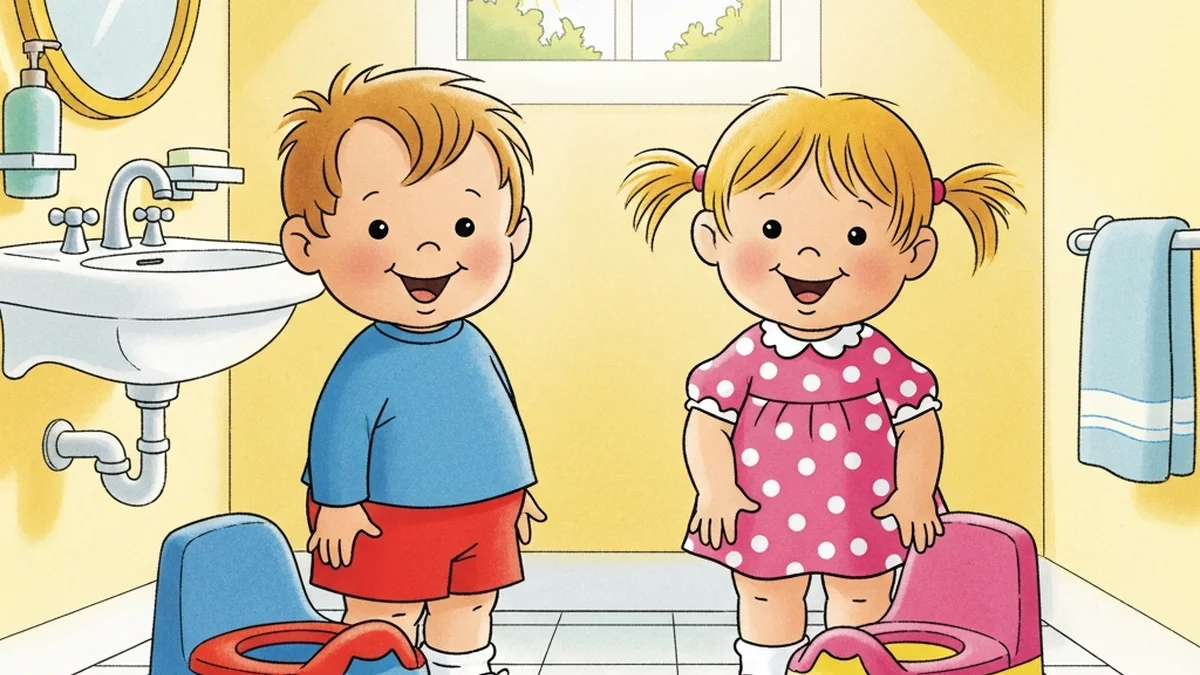
Your neighbor's daughter was trained at 24 months. Your son just turned 3 and still screams when you mention the potty. You start Googling "are boys harder to potty train" at midnight, and suddenly every parenting forum confirms your worst fear: boys are way behind.
But is that actually true? Let's look at what the research says, what's genuinely different, and what doesn't matter nearly as much as the internet wants you to believe.
What the Research Says About Potty Training Boys vs Girls
Studies do show a gap, but it's smaller than you'd think. A study published in Pediatrics found that girls showed readiness signs around 24 months, while boys showed them closer to 26 months. Girls stayed dry during the day by about 32.5 months on average. Boys hit that milestone around 35 months.
That's roughly a 2- to 3-month difference. Not 6 months. Not a year.
The American Academy of Pediatrics puts it a bit wider, saying boys train about 3 to 6 months after girls on average. But here's the part everyone skips: individual variation is huge. Within the same gender, kids can differ by 7 to 14 months. Your son might train earlier than your friend's daughter. It happens all the time.
Where Boys and Girls Actually Differ
There are a few real differences worth knowing about. None of them mean boys are "harder." They just mean the process might look a little different.
The Sitting vs Standing Question
This is the biggest practical difference. Boys need to learn to pee sitting down first. Every pediatric expert agrees on this. Sitting lets them relax the pelvic floor muscles they need for both peeing and pooping. Standing comes later.
A good rule: teach standing up after your son is fully trained and shows interest. That usually happens a few months after he's reliably using the potty. Have a dad, uncle, or older brother model it. And toss a few Cheerios in the toilet for target practice. It works.
The Aim Problem
Toddler boys do not aim well. That's not a training failure. That's just small-child motor skills. Starting seated eliminates this issue entirely. When you do move to standing, expect some cleanup time. A small step stool and a sense of humor go a long way.
Activity Level and Distraction
Some research suggests that toddler boys tend to be more physically active, which can make them less willing to stop what they're doing to sit on a potty. This isn't universal, but if your son would rather climb the bookshelf than sit still for 2 minutes, you're not imagining it.
The fix is simple: keep potty sits short (1 to 3 minutes), and time them around transitions. After meals. Before bath. When he's already slowing down.
Nighttime Dryness
Boys are more likely to have nighttime wetting that lasts longer. A large review of studies found that boys have higher rates of bedwetting than girls across all ages. This isn't a potty training failure. Nighttime dryness is controlled by a hormone (vasopressin) that develops on its own timeline, and boys' timelines tend to run a few months behind.
If your son is dry during the day but still wet at night, that's completely normal up to age 5 and sometimes beyond. Check out our guide to nighttime potty training for more on this.
What Doesn't Actually Differ
Most of potty training is the same regardless of gender. The readiness signs are identical. The strategies work the same. The frustrations feel the same at 2 AM.
- Readiness signs: Staying dry for 2 hours, showing interest in the bathroom, telling you when they've gone in their diaper. Same for boys and girls.
- Best approach: Follow the child's lead, stay consistent, avoid pressure. Works for everyone.
- Regression triggers: New sibling, starting daycare, illness, big moves. Gender doesn't change this.
- Rewards: If you use them, stickers and small rewards work equally well for boys and girls.
The fundamentals don't change. The potty doesn't care about gender. Your child's bladder and brain are developing on their own schedule, and that schedule has more to do with their individual biology than whether they're a boy or a girl.
Tips for Potty Training Boys
If you're training a boy, here are the adjustments that actually help:
- Start seated. Teach peeing and pooping in the same position. It's less confusing and avoids bathroom redecorating.
- Point it down. When your son sits on the potty, gently teach him to point his penis down into the bowl. This prevents the classic spray-over-the-rim situation.
- Use a potty chair, not a seat insert, at first. Many boys feel more stable on a low potty chair. It also keeps them closer to the ground, which helps with the "point down" issue. See our potty chair vs seat insert comparison for more details.
- Let him watch dad. Modeling is the most effective teaching tool, especially for standing up later. If dad's on board, this speeds things up significantly.
- Keep sits short. 1 to 3 minutes. If nothing happens, no big deal. Try again in 30 minutes.
Tips for Potty Training Girls
Girls don't get a free pass just because they might start a couple months earlier. Here's what to focus on:
- Teach front-to-back wiping early. This matters for hygiene. Practice with her, and don't expect her to get it right every time. You'll be helping with wiping for a while.
- Watch for UTIs. Girls are more prone to urinary tract infections, especially during potty training when wiping habits are still developing. If she suddenly starts having more accidents after being dry, or complains about pain when peeing, call your pediatrician.
- Don't assume "early" means "easy." Starting earlier sometimes means a longer training period with more accidents along the way. That's fine. She's still learning.
- Same rules apply. Follow her lead. Stay calm during accidents. Celebrate the wins.
The Real Factor That Matters More Than Gender
Readiness. That's it.
A child who's showing clear readiness signs at 26 months will train faster than a child who's pushed into it at 22 months, regardless of gender. The research is clear: children who start training when they're truly ready finish faster and have fewer setbacks.
So if your son isn't ready at the same age your daughter was, that doesn't mean anything is wrong. And if your daughter is resistant at an age when "all girls should be trained," ignore that noise. She'll get there.
Your child isn't a statistic. They're a whole person learning a brand-new skill. Give them time.
Key Takeaways
- Girls train about 2 to 3 months earlier than boys on average, but individual variation is much bigger than the gender gap.
- Boys should learn to pee sitting down first, then transition to standing after they're fully trained.
- Nighttime dryness takes longer for boys, and that's normal up to age 5.
- Readiness matters more than gender. Follow your child's cues, not a calendar.
- The core strategies for potty training are the same for boys and girls.
Frequently Asked Questions
Are boys really harder to potty train than girls?
Not harder, just sometimes a little slower to start. Research shows boys show readiness signs about 2 months later than girls on average. But the process itself isn't more difficult. Boys who start when they're ready typically train just as smoothly as girls.
Should I teach my son to pee standing up from the beginning?
No. Pediatric experts recommend starting seated for all children. Sitting helps boys relax the pelvic floor muscles needed for both peeing and pooping. Transition to standing once he's reliably trained and interested, usually a few months after daytime dryness is consistent.
At what age should I worry if my son isn't potty trained?
Most boys are daytime trained between 30 and 42 months. If your son isn't showing any interest or readiness signs by 36 months, it's worth mentioning to your pediatrician. But many healthy boys aren't fully trained until closer to 3.5 years old. That's within the normal range.
Why is my daughter having more accidents than I expected?
Starting earlier doesn't always mean finishing faster. Girls who begin training on the younger end of the readiness window may take longer to fully consolidate the skill. Accidents are a normal part of learning for both genders. If she's also complaining about pain or suddenly regressing, check for a UTI.
Does gender affect nighttime potty training?
Yes, somewhat. Boys are statistically more likely to wet the bed for longer. Nighttime dryness depends on a hormone called vasopressin that matures independently of daytime training. Many boys aren't consistently dry at night until age 5 or 6, and that's considered normal. Don't rush dropping the overnight pull-up based on what worked for an older sibling or a friend's child.