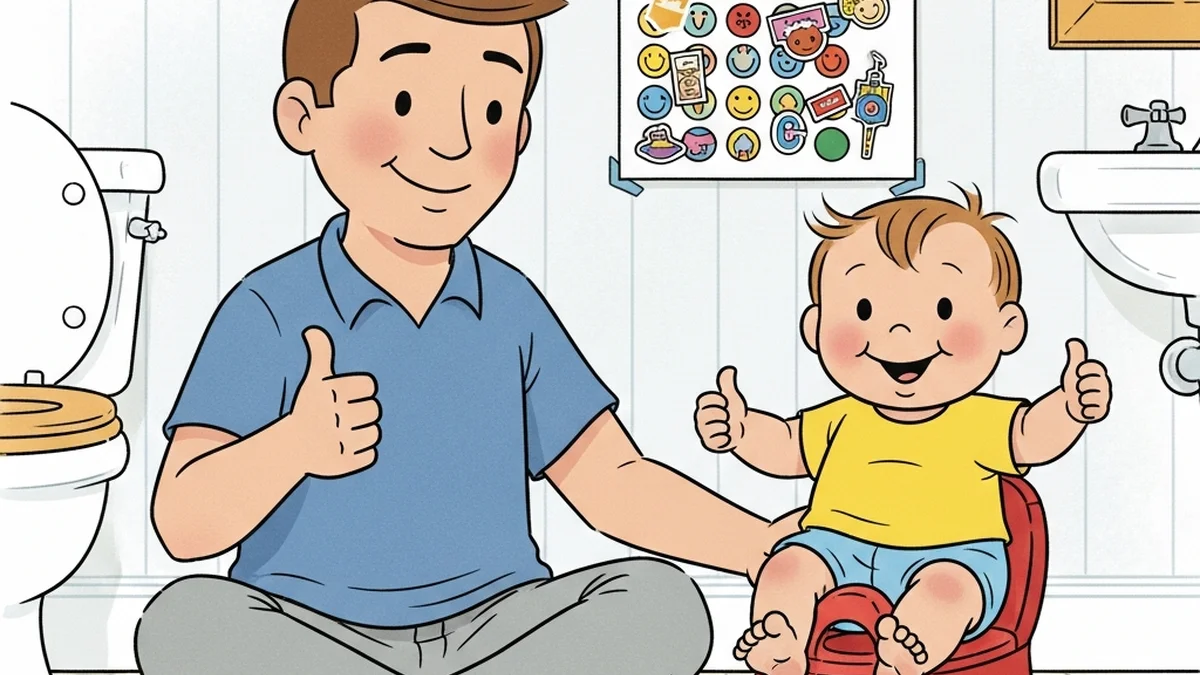
You shut the bathroom door, and three seconds later a tiny hand is pushing it back open. Your toddler toddles in, plops down on their little potty next to you, and stares like you're putting on a show.
So you start to wonder: should your toddler watch you use the bathroom? The short answer is yes, and it's one of the simplest things you can do to help potty training click. Letting your child watch you use the toilet turns an everyday moment into a free lesson.
It feels a little strange the first few times. That's normal. Here's why it works, how to make the most of it, and when to start drawing a curtain.
Why Watching You Actually Helps
Toddlers learn almost everything by copying. They feed a spoon to a stuffed animal because they've watched you feed them. They hold a phone to their ear and babble. The toilet is no different.
When your child sees you sit down, go, wipe, flush, and wash your hands, they're collecting the whole sequence. It stops being a mystery box in the corner of the room and becomes something normal people do, including the person they admire most.
Pediatric and child development sources back this up. Major groups like the American Academy of Pediatrics list modeling as a standard early step, because seeing grown-ups use the toilet makes kids want to do the same. Curiosity about what you're doing in there is even one of the classic signs your toddler is ready to start.
It's free, it's already happening, and it costs you nothing but a little privacy.
How to Turn Bathroom Visits Into Lessons
You don't need a script. A few small habits make the modeling stick.
1. Narrate what you're doing
Keep it simple and matter-of-fact. "Mommy feels like she needs to pee, so she's sitting on the toilet." Then, "All done. Now I wipe, flush, and wash my hands."
Those plain words teach the order of operations and give your child language for body signals. Naming the urge out loud helps a lot, especially for kids who don't yet recognize when they need to go.
2. Let them help with a step
Kids love a job. Let your toddler hand you a square of toilet paper, push the flush button, or turn on the faucet. Being part of the routine builds buy-in faster than watching alone.
3. Put their potty right next to yours
Set a potty chair beside the toilet so they can sit when you sit. No pressure to actually go. The point is for them to practice the posture and feel like your bathroom buddy.
4. Match the model to the child when you can
This matters most for boys learning to stand later on. Boys often pick it up fastest by watching dad, an uncle, or an older brother, which we cover in should boys sit or stand to pee. Girls do great watching mom sit. If a same-gender model isn't around, don't sweat it. Any calm, confident example works.
What If You're Not Comfortable With an Audience?
Plenty of parents feel weird about this, and that's completely fair. You don't have to perform bathroom visits to potty train your child.
If you'd rather keep some privacy, you have good options:
- Use a doll or stuffed animal. "Teddy needs to pee" plus a toy potty gives the same modeling without involving you. Kids copy the doll the same way they'd copy you.
- Let a sibling be the model. An older brother or sister using the potty is often more interesting to a toddler than a parent anyway.
- Pick your moments. Maybe you're fine with pee but not poop. Maybe one parent is comfortable and the other isn't. Both of those are okay.
Modeling is a helpful tool, not a rule. If it makes you tense, your toddler will feel that, and a stressed bathroom is no one's friend.
When Should You Stop Letting Them Watch?
There's no hard age, but most families naturally start pulling back somewhere between ages 3 and 5. Two signals tell you it's time.
First, watch your child. When they start closing the door for their own privacy or telling you "go out," they're showing you that they understand bodies are private. Honor that. It's a healthy step, not a rejection.
Second, watch yourself. When you start feeling like you'd rather have your own privacy back, you're allowed to take it. You can say, "I'm going to use the bathroom by myself now, and you can wait right here." That teaches an important lesson too: people get privacy in the bathroom.
This is also a natural time to start gentle words about private parts and bathroom boundaries, both at home and in public. Keep it neutral and low-key. You're not undoing the modeling, you're adding the next chapter.
The Reassuring Part
If your toddler has been your bathroom shadow for months, you have not created a weird habit. You've been doing exactly what experts suggest, even by accident.
And if your kid has zero interest in watching you? That's fine too. Some children learn the whole thing from a doll, a daycare classroom full of potty-using peers, or one fascinated week of copying a big cousin. Watching you is one of many on-ramps, not the only road.
Either way, the curiosity passes, the privacy returns, and your child ends up trained and proud. Six months from now you'll be the one knocking to get a minute alone.
Key Takeaways
- Yes, letting your toddler watch you use the bathroom helps, because toddlers learn the whole routine by copying you.
- Narrate the steps in plain words, let them help with one part, and keep a potty chair next to the toilet so they can sit when you sit.
- Match the model to the child when you can, especially dad or an older brother for boys learning to stand.
- If an audience feels uncomfortable, a doll, an older sibling, or picking your moments works just as well.
- Start easing back when your child asks for privacy or you want yours back, usually between ages 3 and 5.
Frequently Asked Questions
At what age should I start letting my toddler watch me use the bathroom?
There's no minimum age, and most toddlers invite themselves in long before formal training starts. Modeling is useful from around 18 to 24 months, which is when many kids show their first readiness signs. You don't have to wait for a specific birthday to let them watch.
Is it bad for my toddler to watch me use the toilet?
No. It's a normal, widely recommended part of early potty learning. The only time to adjust is when your child starts wanting privacy or you do, which is a healthy cue to gently scale back rather than a sign anything went wrong.
My child only wants to watch the opposite-gender parent. Does that matter?
Not really. A confident, calm example is what helps, not a perfect gender match. Same-gender modeling is most useful later, when a boy is learning to pee standing up. For everyday sitting, any parent works fine.
What if I don't want my toddler watching me at all?
That's completely valid. Use a potty training doll, let an older sibling be the model, or simply talk through the steps without an audience. Modeling is one helpful option among many, and plenty of kids train without ever watching a parent.
How do I get my toddler to stop following me into the bathroom?
Start with a clear, friendly script: "I'm going by myself, and you can wait here with your book." Offer a quick activity to hold them, keep your tone calm, and stay consistent. Most kids accept the new boundary within a week or two once they see it's steady.