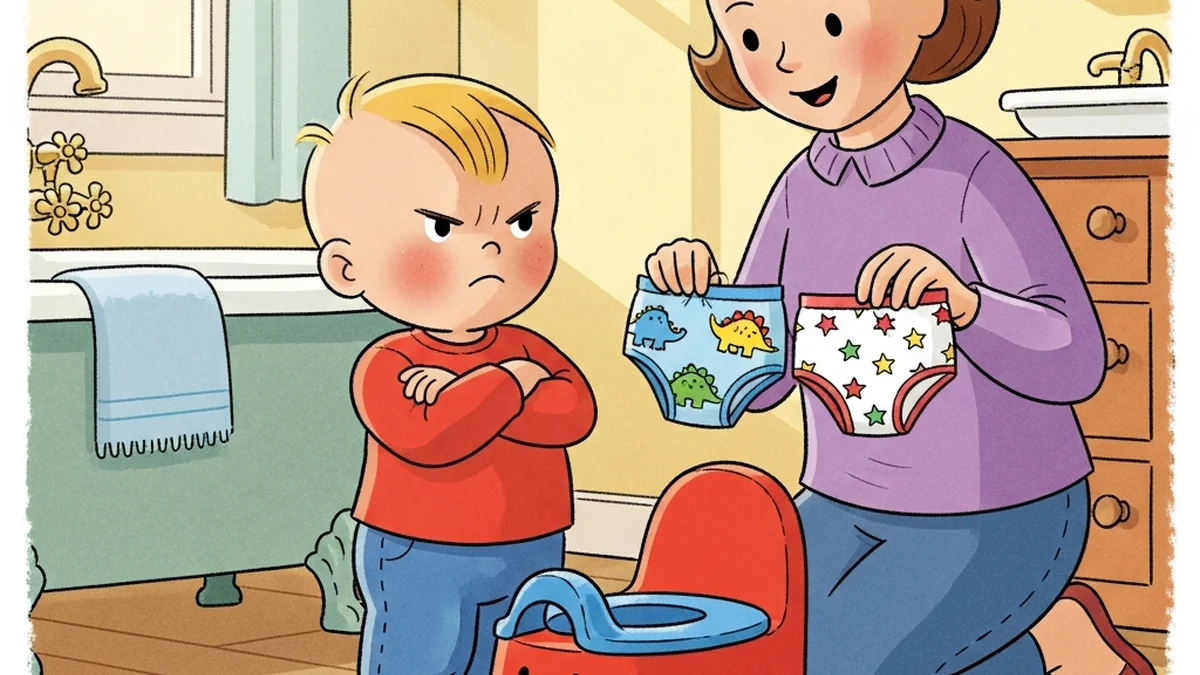
You've asked "Do you need to go potty?" eleven times today. Each time, the answer is the same: a loud, defiant "NO!" Meanwhile, the wet underwear pile is growing. You know they can do it. They've done it before. But right now, it feels like you're in a standoff with someone who's 3 feet tall and completely winning.
If potty training has turned into a daily battle of wills, you're dealing with a power struggle. And here's the thing most parents don't realize at first: you can't win this one by pushing harder. You win by stepping back.
Why Potty Training Becomes a Power Struggle
Toddlers between ages 2 and 3 are wired to test boundaries. They're figuring out that they're a separate person from you, and they want to prove it. The problem is, almost everything in their life is controlled by someone else. When they eat, what they wear, where they go. All decided by adults.
Potty training hands them something they actually control: their own body. And when they sense it matters a lot to you, that control becomes even more appealing. The more you push, the harder they dig in. It's not about the potty anymore. It's about who's in charge.
This is different from general potty training resistance, where a child just isn't ready or is afraid. Power struggles happen when your child can use the potty but won't, specifically because they've realized saying "no" gets a big reaction from you.
Signs You're in a Power Struggle
Not every refusal is a power play. Here's how to tell the difference:
- They've used the potty successfully before but now refuse consistently.
- The refusal comes with attitude, not anxiety. They're defiant, not scared.
- They go right after you stop asking. The second you walk away, they use the potty on their own or have an accident they seem unbothered by.
- You're getting emotional about it. If you're frustrated, angry, or pleading, your child can feel that, and it fuels the cycle.
- Prompting makes it worse. The more you remind them, the more they resist.
If this sounds familiar, the issue isn't readiness. Check our 8 signs of potty training readiness if you're not sure. The issue is control.
5 Ways to End the Potty Training Power Struggle
1. Stop asking "Do you need to go potty?"
This is the single biggest change you can make. That question, asked over and over, practically begs for a "no." Your toddler hears it as a chance to assert themselves, and they take it every time.
Instead, try stating it neutrally: "It's time to try the potty before we go outside." No question mark. No negotiation. You're not asking permission. You're building it into the routine the same way you'd say "time to put on shoes."
If even that creates pushback, try a when/then statement: "When you've tried the potty, then we can go to the park." Calm. Matter-of-fact. No drama.
2. Offer choices that don't include "no"
Toddlers who feel controlled need to feel like they have a say. Give them choices, but make both options lead to the potty.
- "Do you want to use the big toilet or your potty chair?"
- "Do you want to go potty before or after you wash your hands?"
- "Which book do you want to look at while you sit?"
The trick is that "not going" isn't one of the options. They get autonomy over the how, not the whether. This works because it gives them the feeling of control without actually skipping the potty.
3. Drop the constant reminders
Prompting a toddler to use the potty every 15 to 20 minutes is a recipe for a standoff. They start tuning you out, or worse, they start resisting on principle.
Instead, watch for their signals. Most kids have a tell: the potty dance, the crotch grab, the sudden stillness. Learn your child's pattern and offer the potty at those moments only, plus before leaving the house and before bed.
Cutting prompts from 10 times a day to 3 or 4 can shift the whole dynamic within a week.
4. Go neutral on the outcome
This one is counterintuitive, but it works. If your child senses that using the potty makes you thrilled and accidents make you upset, they've found a lever. Your emotions become their tool.
Try to keep your reaction the same either way. A calm "Let's clean up" for accidents. A simple "Nice work" for successes. No sticker parties. No visible disappointment. When the potty stops being a way to control your feelings, it loses its power as a bargaining chip.
This doesn't mean you can't celebrate. Just match their energy rather than turning every pee into a parade.
5. Give them control everywhere else
A toddler who feels powerless in their daily life will fight harder at the potty. Look for low-stakes places to hand over control:
- Let them pick their outfit (even if it doesn't match)
- Let them choose between two snack options
- Let them decide which underwear to wear today
- Give them a "job" like carrying the napkins to the table
When kids feel independent in other areas, they have less need to fight you at the potty. It sounds unrelated, but it works. Pediatricians at Boston Children's Hospital specifically recommend this approach for families stuck in potty standoffs.
When to Take a Full Break
Sometimes the best move is to pause. Pediatricians suggest a 1- to 3-month break from potty training if the power struggle has been going on for more than 2 weeks with no improvement.
That doesn't mean you've failed. It means the pressure cooker needs to cool down. Put the diapers or pull-ups back on. Stop mentioning the potty. Let your child come back to it on their own terms.
Many parents report that after a break, their child starts asking to use the potty by themselves. When the pressure disappears, so does the need to fight.
What Not to Do
- Don't punish accidents. Ever. Shame makes power struggles worse, not better.
- Don't use forced sits. Making a child sit on the potty until they go creates negative associations that can last months.
- Don't compare them to other kids. "Your cousin uses the potty" is not motivating. It's humiliating.
- Don't bribe your way out. If rewards aren't working, bigger rewards won't either. The issue isn't motivation. It's control.
Key Takeaways
- Potty training power struggles happen when your toddler uses the potty as a way to assert control, not because they can't do it.
- Stop asking "Do you need to go?" and switch to neutral routine statements or when/then language.
- Offer choices that both lead to the potty, so your child feels in charge of the how.
- Go neutral on your reactions to both successes and accidents to remove the emotional lever.
- If the standoff has lasted more than 2 weeks, take a 1- to 3-month break and let them come back to it.
Frequently Asked Questions
At what age do potty training power struggles usually happen?
Power struggles are most common between ages 2 and 3, when toddlers are developing a strong sense of independence and autonomy. They can also happen with older children (3 to 4 years old) who were pushed into training before they were ready or who experienced a lot of pressure early on.
How long do potty training power struggles last?
If you adjust your approach, most power struggles improve within 1 to 2 weeks. If you keep pushing the same way, they can drag on for months. Taking a full break of 1 to 3 months is recommended when the dynamic hasn't shifted after 2 weeks of trying a new approach.
Should I go back to diapers during a power struggle?
Yes, and it's not a step backward. Putting diapers back on removes the pressure and takes the potty off the negotiating table. Many pediatricians recommend this as a reset strategy. When you try again in a month or two, the power struggle dynamic is usually gone.
Is a potty training power struggle the same as resistance?
Not exactly. Resistance often means a child isn't ready, is afraid, or doesn't understand the process yet. A power struggle means the child can use the potty but refuses because they've turned it into a control issue. The fix for resistance is patience and readiness support. The fix for a power struggle is backing off and returning control to the child.
Will my child ever potty train if I stop pushing?
Yes. Healthy children all learn to use the toilet. Backing off doesn't mean giving up. It means removing the pressure that's causing the standoff. Most children will start showing interest again within a few weeks of the pressure being lifted, often sooner than parents expect.